Search Precision Consulting
Type to search · ↑↓ to navigate · Enter to open · Esc to close
Services / Independent Assurance
Delivery and Governance
Independent programme assurance
an honest read on delivery confidence
Boards and sponsors ask us one question more than any other: is this programme really on track? We give the independent, evidence-based answer, in time to do something about it.
Service Outline
What this service delivers
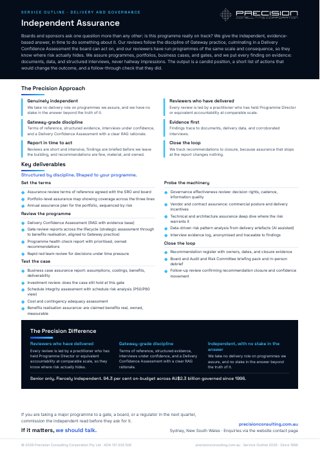
Boards and sponsors ask one question more than any other: is this programme really on track? We give the independent, evidence-based answer, in time to do something about it. Our reviews follow the discipline of Gateway practice, culminating in a Delivery Confidence Assessment the board can act on, and our reviewers have run programmes of the same scale and consequence, so they know where risk actually hides. We assure programmes, portfolios, business cases, and gates, and we put every finding on evidence: documents, data, and structured interviews. The output is a candid position, a short list of actions that would change the outcome, and a follow-through check that they did.
The Precision Approach
How we run this work
Genuinely independent.
We take no delivery role on programmes we assure, and we have no stake in the answer beyond the truth of it.
Reviewers who have delivered.
Every review is led by a practitioner who has held Programme Director or equivalent accountability at comparable scale.
Gateway-grade discipline.
Terms of reference, structured evidence, interviews conducted in confidence, and a Delivery Confidence Assessment with a clear RAG rationale.
Evidence first.
Findings trace to documents, delivery data, and corroborated interviews; our AI tooling scans schedules, risk registers, and financials for patterns humans miss under time pressure.
Report in time to act.
Reviews are short and intensive, findings are briefed before we leave the building, and recommendations are few, material, and owned.
Close the loop.
We track recommendations to closure, because assurance that stops at the report changes nothing.
How We Can Help
Structured by discipline. Shaped to your programme.
These are representative artefacts from our delivery playbooks, tailored, added to, or trimmed to fit each client’s governance model and what the programme actually needs.
Set the terms 3 shown
- Assurance review terms of reference agreed with the SRO and board
- Portfolio-level assurance map showing coverage across the three lines
- Annual assurance plan for the portfolio, sequenced by risk
Review the programme 4 shown
- Delivery Confidence Assessment (RAG with evidence base)
- Gate review reports across the lifecycle (strategic assessment through to benefits realisation, aligned to Gateway practice)
- Programme health check report with prioritised, owned recommendations
- Rapid red-team review for decisions under time pressure
Test the case 5 shown
- Business case assurance report: assumptions, costings, benefits, deliverability
- Investment review: does the case still hold at this gate?
- Schedule integrity assessment with schedule risk analysis (P50/P80 view)
- Cost and contingency adequacy assessment
- Benefits realisation assurance: are claimed benefits real, owned and measurable?
Probe the machinery 5 shown
- Governance effectiveness review: decision rights, cadence, information quality
- Vendor and contract assurance: commercial posture and delivery incentives
- Technical and architecture assurance deep dive where the risk warrants it
- Data-driven risk pattern analysis from delivery artefacts (AI-assisted)
- Interview evidence log, anonymised and traceable to findings
Close the loop 3 shown
- Recommendation register with owners, dates, and closure evidence
- Board and Audit and Risk Committee briefing pack and in-person debrief
- Follow-up review confirming recommendation closure and confidence movement
This is a representative set. If what you need is missing here, ask us.
The Precision Difference
Why boards choose us for this work
Reviewers who have delivered
Every review is led by a practitioner who has carried Programme Director or equivalent accountability at comparable scale, so they know where risk actually hides. The findings come from people who have done the work they are reviewing.
Gateway-grade discipline
Terms of reference, structured evidence, interviews conducted in confidence, and a Delivery Confidence Assessment with a clear RAG rationale. Every finding traces to documents, delivery data, and corroborated interviews.
Independent, with no stake in the answer
We take no delivery role on programmes we assure, and no stake in the answer beyond the truth of it. Recommendations are few, material, and owned, and we track them to closure because assurance that stops at the report changes nothing.
Senior only. Fiercely independent. 94.3 per cent on-budget across AU$2.3 billion governed since 1996.
What we do
Independent Assurance
Independent assurance is only worth having if it is genuinely independent and genuinely expert. Our reviewers have run programmes of the same scale and consequence, so they know where the real risks hide and how to tell whether a plan will hold.
We give a clear, candid position, backed by evidence, on delivery confidence, risk, and the actions that would change the outcome. It is the read a board can rely on when the stakes are highest.

Programme health reviews
A candid, evidence-based read on delivery confidence and risk.
Gate and stage reviews
Objective assessment at the decision points that matter.
Investment and business case assurance
A defensible view of whether the case still holds.
Delivery risk assessment
The real risks, surfaced early enough to act on them.
Board-ready reporting
A position the board can act on with confidence.
Precision Insights
Further reading from our practitioners
Common Questions
The questions we are asked most
What is independent programme assurance?
Independent programme assurance is an objective, expert assessment of whether a programme is likely to deliver what it promised, done by people with no stake in the answer. It gives boards, sponsors and risk committees an honest read on delivery confidence, exposure and the actions needed to protect the outcome. Because it is independent, it surfaces issues that internal reporting can smooth over.
What is a project health check?
A project health check is a structured, independent review of a project or programme at any point in its life, from initiation to closure. It assesses delivery confidence across the areas that decide success, such as scope, plan, governance, risk, resourcing and stakeholder engagement, then sets out clear findings and recommendations. It is the fastest way to get an honest, expert view of where a programme really stands.
What is the difference between a health check and a gateway review?
A gateway review happens at a defined decision point and asks whether the programme should pass to the next stage, while a health check can be run at any time to test overall delivery confidence. Both are best done by independent, experienced practitioners, and both look backwards at what has been done and forwards at what still has to go right.
When should we commission independent assurance?
Commission independent assurance before major decision points, before committing significant further funding, when a programme feels off but you cannot pin down why, or when the board simply needs an objective view. Assurance is most valuable early, when there is still room to act on what it finds. Waiting until a programme is clearly in trouble narrows your options and raises the cost.
How is independent assurance different from internal audit?
Independent assurance is forward-looking and delivery-focused, where internal audit is largely backward-looking and controls-focused. Assurance asks whether this programme will succeed and what must change to protect the outcome, drawing on people who have actually delivered similar programmes. It complements internal audit and the three lines of defence rather than replacing them, and gives the board a practitioner's view.
Will an assurance review disrupt the delivery team?
A well-run assurance review is deliberately designed to be quick and low-disruption. We gather what we need efficiently, respect the team's time, and focus on getting to accurate findings fast rather than sitting over the programme for weeks. Good assurance helps the delivery team by surfacing the real risks early and giving them the mandate to fix them.
What do we get at the end of an assurance review?
You get a clear, honest statement of delivery confidence, the material risks and issues, and a prioritised set of recommendations the board and sponsor can act on. The findings are written for decision-makers, not buried in detail, and rated so it is obvious what needs attention now. Where we can help implement the recommendations we will say so, but the assessment stands on its own.
Ready to Engage?
Talk to us about
Independent Assurance
Initial conversations are confidential and without obligation.
If you are taking a major programme to a gate, a board, or a regulator in the next quarter, commission the independent read before they ask for it.