Search Precision Consulting
Type to search · ↑↓ to navigate · Enter to open · Esc to close
Services / Programme Recovery and Turnaround
Delivery and Governance
Programme recovery
for when a programme has lost its way
We are called in when a programme has stalled, blown its budget, or lost the confidence of the board. We stabilise it, and we return it to a credible, defensible path.
Service Outline
What this service delivers
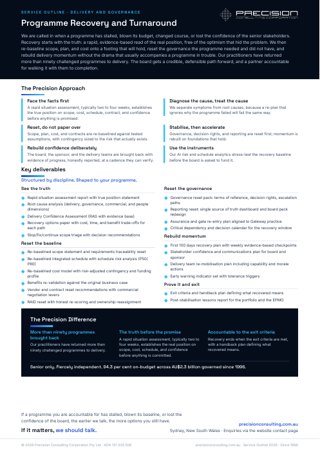
We are called in when a programme has stalled, blown its budget, changed course, or lost the confidence of the senior stakeholders. Recovery starts with the truth: a rapid, evidence-based read of the real position, free of the optimism that hid the problem. We then re-baseline scope, plan, and cost onto a footing that will hold, reset the governance the programme needed and did not have, and rebuild delivery momentum without the drama that usually accompanies a programme in trouble. Our practitioners have returned more than ninety challenged programmes to delivery. The board gets a credible, defensible path forward, and a partner accountable for walking it with them to completion.
The Precision Approach
How we run this work
Face the facts first.
A rapid situation assessment, typically two to four weeks, establishes the true position on scope, cost, schedule, contract, and confidence before anything is promised.
Diagnose the cause, treat the cause.
We separate symptoms from root causes, because a re-plan that ignores why the programme failed will fail the same way.
Reset, do not paper over.
Scope, plan, cost, and contracts are re-baselined against tested assumptions, with contingency sized to the risk that actually exists.
Stabilise, then accelerate.
Governance, decision rights, and reporting are reset first; momentum is rebuilt on foundations that hold.
Rebuild confidence deliberately.
The board, the sponsor, and the delivery teams are brought back with evidence of progress, honestly reported, at a cadence they can verify.
Use the instruments.
Our AI risk and schedule analytics stress-test the recovery baseline before the board is asked to fund it.
How We Can Help
Structured by discipline. Shaped to your programme.
These are representative artefacts from our delivery playbooks, tailored, added to, or trimmed to fit each client’s governance model and what the programme actually needs.
See the truth 5 shown
- Rapid situation assessment report with true position statement
- Root cause analysis (delivery, governance, commercial, and people dimensions)
- Delivery Confidence Assessment (RAG with evidence base)
- Recovery options paper with cost, time, and benefit trade-offs for each path
- Stop/fix/continue scope triage with decision recommendations
Reset the baseline 6 shown
- Re-baselined scope statement and requirements traceability reset
- Re-baselined integrated schedule with schedule risk analysis (P50/P80)
- Re-baselined cost model with risk-adjusted contingency and funding profile
- Benefits re-validation against the original business case
- Vendor and contract reset recommendations with commercial negotiation levers
- RAID reset with honest re-scoring and ownership reassignment
Reset the governance 4 shown
- Governance reset pack: terms of reference, decision rights, escalation paths
- Reporting reset: single source of truth dashboard and board pack redesign
- Assurance and gate re-entry plan aligned to Gateway practice
- Critical dependency and decision calendar for the recovery window
Rebuild momentum 4 shown
- First 100 days recovery plan with weekly evidence-based checkpoints
- Stakeholder confidence and communications plan for board and sponsor
- Delivery team re-mobilisation plan including capability and morale actions
- Early warning indicator set with tolerance triggers
Prove it and exit 2 shown
- Exit criteria and handback plan defining what ‘recovered’ means
- Post-stabilisation lessons report for the portfolio and the EPMO
This is a representative set. If what you need is missing here, ask us.
The Precision Difference
Why boards choose us for this work
More than ninety programmes brought back
Our practitioners have returned more than ninety challenged programmes to delivery. That pattern recognition shows in how quickly we separate symptoms from root causes, and in re-plans that hold because they treat the reason the programme failed.
The truth before the promise
A rapid situation assessment, typically two to four weeks, establishes the real position on scope, cost, schedule, and confidence before anything is committed. The recovery baseline is stress-tested by our AI risk and schedule analytics before the board is asked to fund it.
Accountable to the exit criteria
Recovery ends when the exit criteria are met, with a handback plan defining what ‘recovered’ means. We stay accountable for walking the path with you to completion, and the confidence we rebuild is evidenced at a cadence the board can verify.
Senior only. Fiercely independent. 94.3 per cent on-budget across AU$2.3 billion governed since 1996.
What we do
Programme Recovery and Turnaround
Recovery is where our practitioners have made their name. We move quickly to establish the true position, re-baseline scope, plan, and cost onto a footing that will hold, and restore the confidence of the executive and the board.
We do the hard, unglamorous work of turnaround: surfacing the risks others have avoided, resetting governance, and rebuilding delivery momentum, without the drama that usually accompanies a programme in trouble.
Rapid situation assessment
An honest, fast read of the true position, free of the optimism that hid the problem.
Re-baselining
Scope, plan, and cost reset onto a footing that will actually hold.
Governance reset
The decision-making and assurance the programme needed and did not have.
Stakeholder confidence
Restoring the trust of the board, the sponsor, and the delivery teams.
Delivery re-mobilisation
Momentum rebuilt and the programme returned to a confident path.
Impact and Outcomes
Spotlighting some of our Programme Recovery and Turnaround impact
Precision Insights
Further reading from our practitioners
Common Questions
The questions we are asked most
What is programme recovery?
Programme recovery is the disciplined process of stabilising a troubled or failing programme and getting it back to a credible, deliverable position. It starts with an independent diagnosis of what is actually wrong, resets scope, plan and governance to something achievable, then drives delivery of the reset with tight control. Most troubled programmes are recoverable if the real problems are faced early and honestly.
What are the warning signs a programme is failing?
The warning signs are repeated deadline slips, scope that keeps moving, constant firefighting, and decisions that never quite get made. Watch for re-baselining, status reports that stay green until they suddenly go red, teams asking for more time or money to "pull it back", and bad news that arrives late. When updates feel managed rather than honest, it is time for an independent look.
Can a failing project actually be recovered, or should we stop it?
A failing project can usually be recovered, but not always, and part of our job is to tell you which. We assess how important the outcome still is, whether the programme can proceed as scoped or needs redefining, and whether the organisation has the appetite and resources to fix it. Sometimes the honest answer is to stop or reset, and we will say so.
How do you recover a troubled programme?
We recover a troubled programme in a deliberate sequence: diagnose the real issues quickly and independently, reset scope, plan, budget and governance to something achievable, then execute the reset with disciplined control and honest reporting. Programme failure is rarely about technology. It is usually about process, communication and decision-making, and those are fixable when someone senior takes a grip.
How long does programme recovery take?
An initial diagnosis and stabilisation plan typically takes four to six weeks, so you have a clear picture and a reset quickly. The recovery itself depends on the size of the programme and how far it has drifted. We deliberately front-load the assessment so decisions can be made fast, before more time and money are lost.
Who leads the recovery, and do you replace our people?
A senior recovery lead takes accountability for the reset, working with your existing team rather than replacing it wholesale. The aim is to stabilise delivery and rebuild capability, not to run a permanent shadow organisation. We supplement where there are genuine gaps, transfer knowledge as we go, and hand back a programme your own people can carry forward.
What does programme recovery cost?
Recovery is scoped to the situation, usually starting with a fixed-price diagnosis so you can commit to the full reset with eyes open. The cost of recovery is almost always small against the sunk cost and continuing burn of a programme that is quietly failing. We give you a clear price and set of deliverables before the substantive work begins.
Ready to Engage?
Talk to us about
Programme Recovery and Turnaround
Initial conversations are confidential and without obligation.
If a programme you are accountable for has stalled, blown its baseline, or lost the confidence of the board, the earlier we talk, the more options you still have.